
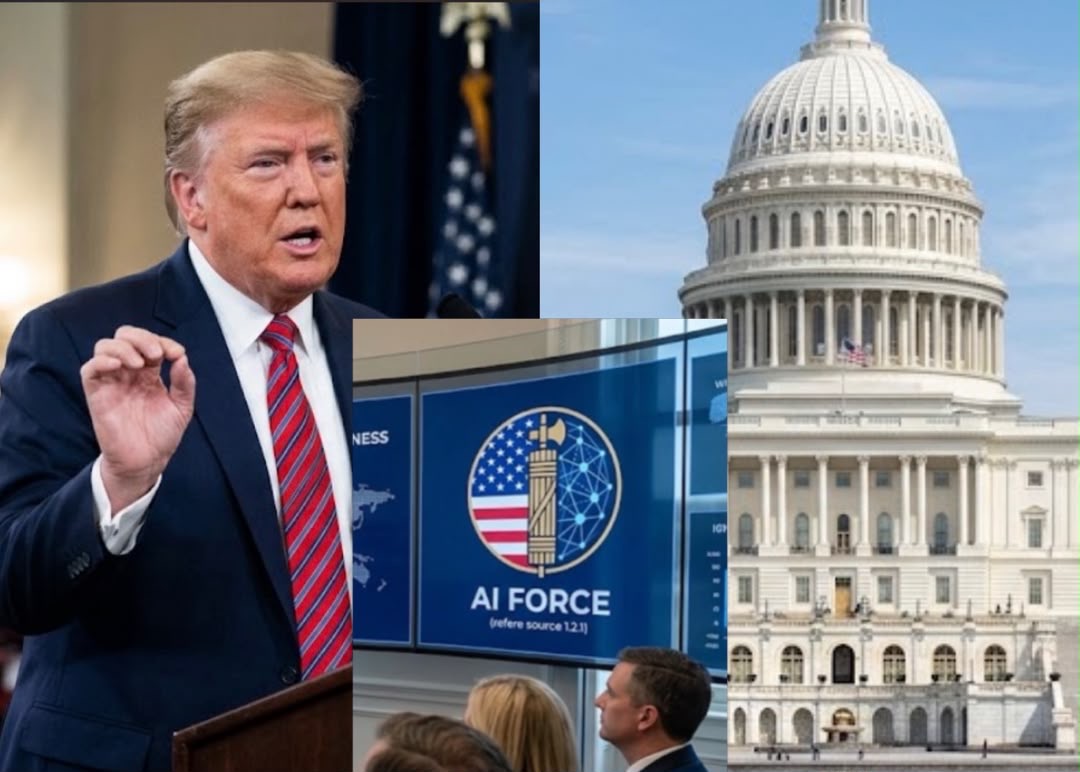
Trump’s Proposed AI Force Aims for $20 Billion — But To What End?
By PlanetStroke Staff
WASHINGTON — Donald Trump’s call for a federally backed “AI Force” and a powerful AI “czar” is more than a branding exercise. It signals an attempt to lock in a large, long‑term federal role in artificial intelligence, with insiders floating a price tag that could reach $20 billion. The question isn’t just whether Congress will fund it — it’s what kind of AI state the U.S. is about to build.
The Proposal: An AI Force With Space Force Ambitions
Trump has framed the AI Force as a signature initiative for his administration, likening it to the Space Force created during his first term. The new entity would be led by an AI czar charged with coordinating federal efforts on artificial intelligence across national security, economic policy, and industry regulation.
Public details remain sparse. The White House has not clarified whether the AI Force would sit inside the Pentagon, under a civilian department, or operate as a cross‑agency coordinating body. No formal org chart has been released, and the administration has not yet submitted an official budget request to Congress. Reporting so far suggests the internal planning number is “up to” $20 billion, but even that figure appears more like a ceiling than a concrete proposal.
What $20 Billion Actually Buys in AI Infrastructure
“$20 billion for AI” sounds abstract. In practice, it would fund a very specific kind of machine‑age bureaucracy.
At today’s prices, a single top‑tier AI supercomputing cluster — tens of thousands of cutting‑edge GPUs, high‑speed networking, and specialized storage — runs in the low single‑digit billions of dollars when you include hardware, data‑center build‑out, and multi‑year operating costs. A $20 billion envelope could plausibly support:
- Two to three national‑scale compute hubs designed to train frontier‑level models for defense, intelligence, and critical infrastructure simulations.
- Multiple new or expanded data centers with hardened physical security, redundant power, and cooling built for AI workloads — effectively, the federal government’s answer to hyperscale cloud campuses.
- Dedicated AI research programs in areas like autonomous defense systems, cyber operations, logistics optimization, and AI safety, each staffed by joint teams from agencies, labs, and universities.
- A talent surge of several hundred to a few thousand AI engineers, data scientists, and policy specialists on government salaries, plus large contracting budgets for private firms that already dominate the frontier model space.
- Data pipelines and security — everything from classified data‑labeling programs to secure environments for training and testing models on sensitive U.S. and allied information.
In other words, $20 billion doesn’t buy a single monolithic AI “brain.” It buys infrastructure: compute, real estate, secure networks, and long‑term human capital. It would effectively create a permanent AI platform inside the federal government — one that outlasts any single administration.
AI, China, and the Shape of a New Arms Race
Trump has repeatedly tied U.S. AI ambitions to competition with China, casting the technology as a pillar of national strength alongside missiles, ships, and chips. That framing reflects a broader reality: the U.S. and China are now locked in a race to apply AI to everything from intelligence analysis to autonomous weapons and industrial planning.
For Washington, an AI Force could function as a central node in that contest — pulling together fragmented efforts now spread across the Pentagon, intelligence community, energy labs, and civilian agencies. A coherent strategy could reduce duplication, speed deployment of useful systems, and set government‑wide standards for how advanced models are tested, secured, and used.
But centralization cuts both ways. A highly visible AI Force could become a political lightning rod, especially if its mandate blurs into domestic surveillance, content moderation, or labor‑displacing automation. In a world where AI is already polarizing, the institution meant to coordinate U.S. power in the space could easily become a proxy for larger fights over privacy, jobs, and the role of the state in shaping technology.
Congress Holds the Key — And the Brakes
Any serious attempt to stand up an AI Force at the $20 billion scale runs directly through Congress. Lawmakers would need to authorize the new entity, define its mission, and appropriate the funds — all while existing agencies defend their turf and contractors circle for influence.
Expect several friction points:
- Mission creep and overlap. Defense, intelligence, and civilian agencies already run significant AI programs. Committees will ask why a new structure is necessary and whether it cannibalizes or duplicates ongoing work.
- Oversight and civil liberties. Members from both parties are likely to demand guardrails: limits on domestic applications, reporting requirements for AI use in surveillance and targeting, and mechanisms for independent auditing of high‑risk systems.
- Regional politics. The placement of new data centers, labs, and offices will quickly become a jobs-and‑contracts battle, pitting states and districts against one another and inviting amendments that fragment the initiative.
- Budget pressure. A request in the tens of billions will land in a crowded landscape of defense modernization, social spending, and deficit concerns. Even supporters of a strong AI posture may push for a smaller, phased‑in approach.
All of this means the headline number is likely to shrink, stretch over multiple years, or become heavily conditioned on detailed plans that the administration has not yet produced. The politics favor symbolism — the creation of an AI Force and a czar — over immediate, fully funded transformation.
Why This Matters
The AI Force debate is not just another budget fight; it’s an early test of how the U.S. intends to govern frontier‑level AI.
On paper, a well‑designed AI Force could do three things that matter:
- Make AI capacity a national asset, not a corporate accident. Right now, the most advanced AI capabilities sit inside a handful of private companies. A federal AI platform could give the U.S. government its own enduring infrastructure for defense, public health, disaster response, and scientific discovery.
- Impose consistent standards on powerful systems. Central coordination could force common testing, red‑teaming, and safety baselines across agencies, reducing the risk that one part of government deploys brittle models in high‑stakes settings.
- Signal seriousness in the U.S.–China race. A visible, well‑funded AI institution would tell allies and rivals that the U.S. intends to compete at scale, not just through ad hoc grants and pilot projects.
But the more likely outcome, at least initially, is more modest: a branded office with limited staff, an impressive‑sounding title for the AI czar, and a budget that falls far short of the rhetoric. The gravitational pull of U.S. politics tends to turn big ideas into layered bureaucracies and incremental pilots.
PlanetStroke’s view: the real risk isn’t that the U.S. spends too much on AI infrastructure — it’s that it spends just enough to create the appearance of action without building the capabilities, safeguards, and talent base needed to matter. An AI Force that is underfunded, under‑empowered, or poorly scoped could lock in a decade of muddled policy at precisely the moment when clarity is most needed.
The next moves — who is chosen as AI czar, where the infrastructure is built, how tight the guardrails are, and what Congress is actually willing to fund — will determine whether the AI Force becomes a cornerstone of U.S. strategy or another acronym in a crowded Washington alphabet.




Leave a Reply