
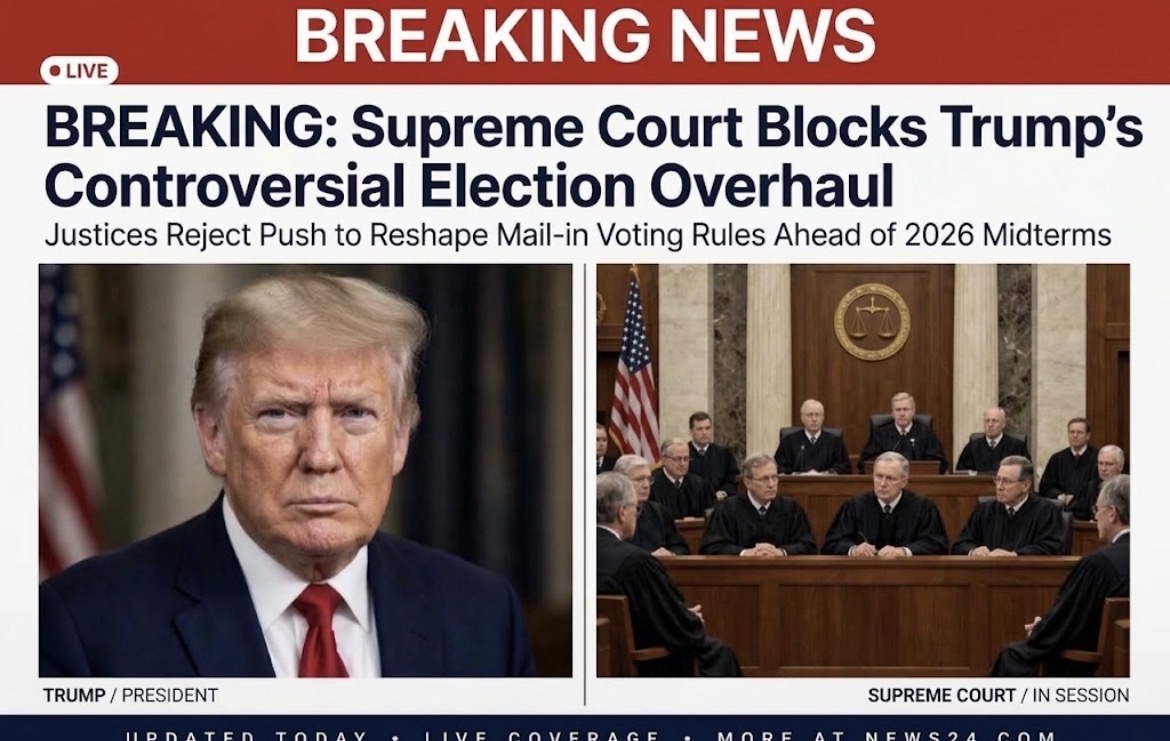
Supreme Court Blocks Trump’s Mail-In Voting Restrictions in Major Legal Setback as Battle Over America’s Midterm Election Rules Intensifies
WASHINGTON, D.C. — The US Supreme Court has dealt President Donald Trump’s administration a significant legal setback in its efforts to introduce new restrictions on mail-in voting ahead of the November 3, 2026, midterm elections, intensifying a nationwide dispute over presidential authority, voting rights and the administration of federal elections.
In a September 14 decision, the Supreme Court declined to lift a lower court order blocking the US Postal Service from enforcing new rules governing mail-in ballots. The ruling prevented the administration from implementing the contested requirements while the underlying legal challenges continue. <Cite refs={[“turn776031news14”,“turn776031search2”]}/>
The dispute represents a major development in Trump’s broader campaign to increase federal involvement in election procedures, an effort that has encountered opposition from Democratic-led states, voting-rights organisations and officials responsible for administering elections.
With the midterms approaching, the legal battle has raised questions about how far the president can go in changing voting procedures and whether federal agencies can impose new requirements on state-administered elections without clear congressional authorisation.
Supreme Court refuses to revive contested voting rules
The court’s decision followed legal challenges to a new Postal Service rule developed after Trump’s March executive order on election administration.
The proposed requirements included having states provide lists of eligible mail-ballot recipients and introducing unique barcodes on ballot envelopes. Under the administration’s plan, the Postal Service could refuse to handle certain ballots that did not comply with the new standards.
Opponents argued that introducing these requirements shortly before a major election could disrupt ballot delivery and prevent eligible voters from having their votes counted.
The Supreme Court declined the Justice Department’s request to suspend the lower court’s injunction, leaving the restrictions blocked while the legal proceedings continued. Justices Samuel Alito and Clarence Thomas dissented from the decision. <Cite refs={[“turn776031news14”,“turn776031search9”]}/>
The decision did not amount to a final ruling on every aspect of Trump’s executive order. Rather, it left the specific Postal Service restrictions subject to the existing court order.
That distinction matters because the administration’s wider election agenda involves several separate legal disputes, each of which may be resolved differently.
Trump’s administration seeks greater federal oversight
Trump has repeatedly called for stricter voting requirements and increased federal involvement in election administration, arguing that stronger safeguards are necessary to protect election integrity.
His March executive order directed federal agencies to develop measures involving citizenship verification, voter information and mail-in ballots. The administration has defended its efforts as a means of ensuring that only eligible citizens participate in federal elections.
However, critics contend that the proposed measures could exceed presidential authority and interfere with the responsibilities of state and local election officials.
The US Constitution gives states a central role in administering congressional elections, while also giving Congress authority to regulate the timing and manner of those elections. The extent to which executive agencies may introduce additional requirements without congressional approval has consequently become a central question in the litigation.
In an earlier phase of the dispute, the Supreme Court lifted a separate injunction against parts of Trump’s executive order in August, finding that the states’ claims were premature at that stage. The justices also made clear that the decision did not establish that every measure subsequently taken to implement the order would necessarily be lawful. <Cite refs={[“turn776031search1”,“turn776031search15”]}/>
The legal developments therefore present a more complicated picture than a single court victory or defeat for either side.
California lawsuit adds another front to the election battle
The administration’s legal campaign has also extended to California, where the Justice Department filed a lawsuit on October 15 seeking to prevent the state from counting mail-in ballots from more than 20,000 voters whom federal officials allege may be noncitizens.
The Justice Department argued that the state had failed to verify the citizenship status of individuals on its list. California officials disputed the administration’s approach, questioning the reliability of the information and warning that eligible voters could be wrongly affected.
The case is separate from the Postal Service dispute and does not establish that the Supreme Court has blocked the administration’s broader election initiatives.
Reuters reported that the lawsuit marks an escalation in the administration’s pressure on state election officials ahead of the November vote. <Cite refs={[“turn776031news3”,“turn776031news6”]}/>
The controversy has also revived debate over the scale of noncitizen voting in federal elections. Voting by noncitizens in federal elections is illegal, but available evidence indicates that such cases are rare. The dispute centres partly on whether the administration’s identification methods can reliably distinguish ineligible voters from eligible citizens.
Democrats and voting-rights groups challenge Trump’s approach
Democratic officials and voting-rights organisations have argued that the administration’s proposals could create unnecessary obstacles for legitimate voters, particularly if new requirements are introduced shortly before election day.
They also maintain that states should retain their established authority over election administration unless Congress has lawfully changed the governing rules.
The administration, by contrast, has defended its efforts as necessary to strengthen election security and improve confidence in voting procedures.
The disagreement has developed into a wider constitutional debate over the balance of power between the White House, Congress, the courts and state election authorities.
While the Supreme Court’s September decision provided a setback for the administration’s Postal Service rule, it did not resolve every legal question surrounding Trump’s election policies.
What the ruling means for the November midterms
The November 3 elections will determine control of the House of Representatives and the Senate, making election administration a particularly sensitive issue for both major parties.
Republicans currently hold narrow majorities in both chambers, and the results will shape the final two years of Trump’s presidency.
The Supreme Court’s decision means the contested Postal Service restrictions cannot be enforced under the blocked rule while the relevant court order remains in place. Other election-related policies, however, are subject to their own legal proceedings and must be assessed individually.
The dispute is likely to remain a major political issue as election officials prepare for voting and campaigns intensify their efforts to mobilise supporters.
For Trump, the legal challenges represent an obstacle to parts of his effort to reshape federal election procedures. For his critics, the proceedings demonstrate the role of judicial review in determining the limits of executive power.
Ultimately, the legal question is not simply whether a president supports stricter voting rules, but whether the measures adopted by the administration are authorised by law and consistent with the constitutional division of election responsibilities.
As the midterms approach, the outcome of the remaining cases could have important consequences for the administration’s election agenda and the rules governing how Americans cast their ballots.




Leave a Reply